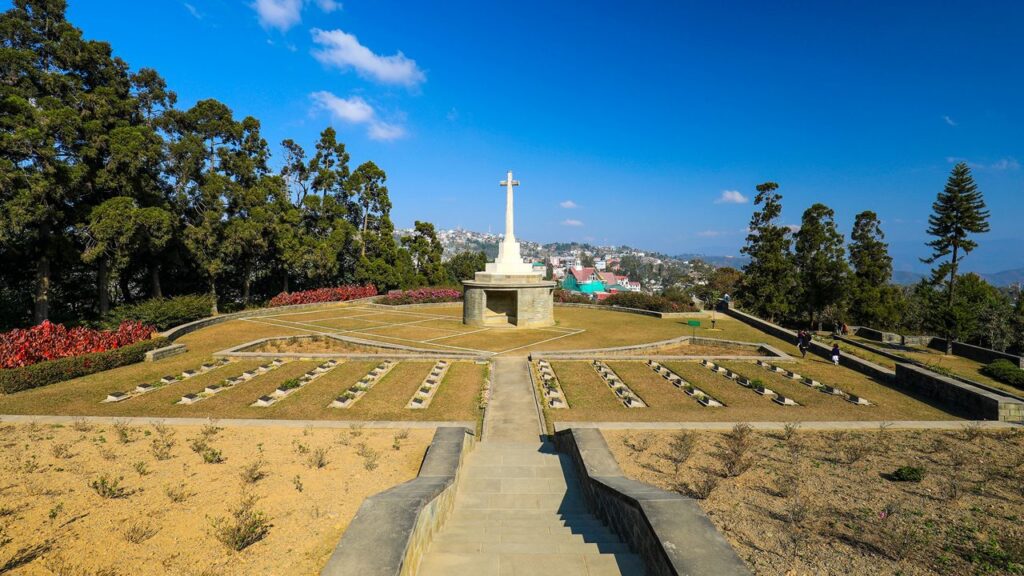
The December Hornbill Festival brings all of Nagaland's tribes together, alongside a moving Second World War cemetery.
Kohima is where Nagaland’s mountains, tribal heritage and wartime history come together. Set amid the green hills of Nagaland at roughly 1,444 metres, the state’s capital offers a very different experience from India’s more conventional hill destinations. It is a city of winding mountain roads, Naga villages, traditional culture, quiet viewpoints and powerful historical stories.
The city is particularly interesting because Kohima isn’t simply a gateway to Nagaland—it is an experience in itself. Its Angami Naga heritage, World War II history, proximity to Dzükōu Valley and access to villages such as Khonoma make it an excellent base for discovering the cultural and natural side of the state.
🏔️ A Hill Capital With a Distinct Identity
Kohima sits along a high ridge surrounded by hills and valleys. The name is derived from Kewhira, the name of the village around which present-day Kohima developed. The city became the capital of Nagaland when the state achieved full statehood on 1 December 1963.
The indigenous inhabitants of the wider district are predominantly Angami Nagas, although Kohima today is a cosmopolitan capital where people from different Naga tribes and other parts of India live.
This mix of traditional and contemporary life is one of the most fascinating aspects of exploring the city.
🪖 Kohima War Cemetery — A City With a Powerful History
One of the most moving places in Kohima is the Kohima War Cemetery, located in the heart of the city.
The cemetery commemorates soldiers of the Allied forces who died during the Battle of Kohima in 1944, when Japanese forces advanced into India during World War II. The cemetery occupies the battlefield area around Garrison Hill and is maintained as a peaceful memorial overlooking the surrounding hills.
The famous inscription at the memorial captures the significance of the place:
“For your tomorrow, we gave our today.”
Beyond the history, the cemetery’s beautifully maintained terraces and panoramic setting make it an unusually quiet place for reflection.
🎭 Kisama Heritage Village — Experience Naga Culture
About 12 km from Kohima, Kisama Heritage Village is one of the best places to understand Nagaland’s diverse tribal traditions.
The heritage complex recreates traditional Naga village architecture through Morungs, or traditional youth dormitories, representing different Naga tribes. These spaces provide a window into traditional architecture, customs, crafts, food and community life.
Kisama becomes particularly vibrant during the Hornbill Festival, held annually in December. The festival brings together Naga tribes through cultural performances, food, handicrafts, music, traditional games and other events.
For Wander-Wise, this is an ideal Local Experience because visitors aren’t simply looking at a monument—they are getting closer to the living cultural identity of Nagaland.
🌿 Khonoma Green Village
Around 20 km from Kohima, Khonoma is one of the region’s most interesting village experiences.
Known as Khonoma Green Village, it is surrounded by beautifully carved agricultural terraces and has developed a strong conservation identity. The village is associated with the Khonoma Nature Conservation and Tragopan Sanctuary, which protects local biodiversity including the endangered Blyth’s tragopan.
Khonoma also carries considerable historical significance because of its resistance to British expansion in the 19th century.
Today, however, the experience is much more peaceful: walk through the village, explore its terraces, meet locals and appreciate the relationship between community, agriculture and conservation.
🥾 Dzükōu Valley — Into Nagaland’s Wild Side
One of the biggest reasons travellers base themselves around Kohima is access to Dzükōu Valley.
Located around 30 km south of Kohima and at an altitude of approximately 2,438 metres, the valley is characterised by rolling green hills, streams and seasonal flowers. The surrounding landscape has earned it a reputation as one of Northeast India’s most beautiful trekking destinations.
The experience is very different from sightseeing in Kohima itself.
You leave the city behind and enter a landscape of:
rolling green ridges
bamboo vegetation
mountain streams
seasonal flowers
dramatic valleys
expansive viewpoints
For adventure travellers, Dzükōu is one of the strongest experiences to add to a Kohima itinerary.
⛰️ Japfu Peak
At 3,048 metres, Japfu Peak is the second-highest peak in Nagaland and offers a more demanding mountain experience near Kohima. The official district tourism information identifies November to March as the best season for climbing Japfu.
The Japfu range is also famous for its rhododendrons, including a giant rhododendron tree recorded in the Guinness Book of World Records.
For travellers who enjoy trekking and sunrise viewpoints, Japfu offers a more adventurous alternative to simply exploring the city.
⛪ Kohima Cathedral
The Kohima Cathedral, formally the Cathedral of Mary Help of Christians, is another distinctive landmark.
Set on a hillside, the church combines elements of Catholic architecture with local Naga influences and offers beautiful views over the city. It is particularly worth visiting for travellers interested in architecture, religion and the cultural evolution of Kohima.
🏘️ Kohima Village — The Old Soul of the City
Kohima Village, also known as Bara Basti, is closely tied to the city’s origins. The district administration identifies it as the village from which the name Kohima evolved.
Walking through this older part of the city provides a more grounded experience than visiting only formal tourist attractions. Traditional houses, local neighbourhoods and everyday life give you a sense of the city’s Naga roots.
🌶️ Discover Naga Food
A Kohima trip should also include a deliberate exploration of Naga cuisine.
Expect bold flavours, smoked ingredients, fermented foods, local greens and the famous Naga King Chilli.
Look beyond standard restaurants and explore local food experiences to discover dishes prepared in traditional ways.
The Hornbill Festival is particularly useful for food discovery because its programme includes a dedicated local cuisine and food festival component.
🎉 Hornbill Festival
If you want to experience Nagaland at its most vibrant, plan around the Hornbill Festival.
Held at Kisama, the festival showcases Naga tribes, traditional performances, handicrafts, food, music, indigenous games and contemporary cultural expressions. The official tourism material describes it as a major cultural showcase of Nagaland’s ethnic diversity.
The festival traditionally takes place during the first week of December, with the Kohima district tourism page specifying 1–7 December for the annual event.
However, expect significantly higher visitor numbers during the festival period.
🌧️ Weather & Best Time to Visit
Kohima has a relatively moderate hill climate compared with much of mainland India’s plains. Winters are cool, while summer is comparatively pleasant, although the monsoon brings substantial rainfall. December and January are the coldest months, while July and August are particularly wet.
Best overall:
October to May
Best for:
December — Hornbill Festival and winter atmosphere
November–March — trekking and comfortable sightseeing
Spring — attractive for flowers and greenery around trekking areas
Monsoon:
June–September can be very wet, making trekking and mountain travel more unpredictable.
🗺️ How Many Days Do You Need?
I’d recommend 3–4 days for a meaningful Kohima trip.
Day 1
Kohima city → War Cemetery → Cathedral → local markets → Naga food
Day 2
Kisama Heritage Village → Hornbill cultural experience → surrounding villages
Day 3
Khonoma Green Village → village walk → conservation landscape
Day 4
Dzükōu Valley trek or Japfu Peak, depending on fitness, weather and available time.
If you’re primarily visiting for the Hornbill Festival, extend your stay and use Kohima as the base for exploring the surrounding region.
🧭 Wander-Wise Perspective
Kohima is best experienced slowly.
Don’t treat it simply as the place you sleep before heading to Dzükōu Valley. Spend time walking through the city’s older neighbourhoods, understanding Naga history at the War Cemetery, experiencing tribal heritage at Kisama, eating local food and then heading into the surrounding hills.
What makes Kohima special is the way history, indigenous culture and mountain landscapes exist together.
You can spend the morning reflecting on a World War II battlefield, the afternoon learning about Naga traditions and the next day walking through one of Northeast India’s most spectacular mountain valleys.
Come for the hills. Stay for the stories, culture and people that make Kohima unlike any other Indian hill capital.
Location on Map
WHY VISIT
Why Visit Kohima?
Discover what makes Kohima a destination worth experiencing.
Scenery
The landscapes around Kohima are the main reason most people make the trip.
Local Culture
Food, festivals and daily life in Nagaland that you will not find in a guidebook.
Things To Do
Enough to fill 3-4 days without rushing between sights.
Best Season
Oct-Dec offers the clearest weather and the most open routes.
Photo Gallery
Discover Kohima through beautiful photographs.
Top Attractions
Kohima Main Viewpoint
The most photographed outlook in Kohima, best in the soft light just after sunrise.
1 Hour
Free
Best Time:
Sunrise
Kohima Old Quarter Walk
A slow wander through the older lanes of Kohima, where the everyday rhythm of Nagaland is easiest to see.
2-3 Hours
Free
Best Time:
Morning
Kohima Heritage Site
The principal historic or natural landmark at Kohima and the reason most itineraries include it.
2 Hours
Rs 25-600
Best Time:
Morning
Kohima Local Market
Produce, crafts and street food. Come hungry and carry small notes.
1-2 Hours
Free
Best Time:
Late afternoon
Kohima Sunset Point
The spot locals head to at the end of the day, and usually the best photograph you will take in Kohima.
1 Hour
Free
Best Time:
Sunset
Suggested Itinerary
1
Arrival and Settling In
Meals
Breakfast not included
2
The Main Sights
Meals
Breakfast
3
Getting Out of Town
Meals
Breakfast, packed lunch
4
Slow Morning and Departure
Meals
Breakfast
Estimated Budget
Accommodation
3600
Mid-range guesthouse or 3-star hotel, per night.
Food and Drink
2000
Three meals a day at local restaurants.
Local Transport
1600
Shared taxis, autos and short transfers.
Activities and Entry
1300
Site entry fees and one paid activity.
Miscellaneous
500
Tips, SIM, laundry and small extras.
Weather & Best Time to Visit
Understand the weather throughout the year to plan the perfect trip.
January
Moderate
Temperature
-5 to 10 C
Rainfall
Minimal
Humidity
Low
February
Moderate
Temperature
-5 to 10 C
Rainfall
Minimal
Humidity
Low
March
Moderate
Temperature
15 to 25 C
Rainfall
Minimal
Humidity
Low
April
Moderate
Temperature
15 to 25 C
Rainfall
Minimal
Humidity
Low
May
Moderate
Temperature
15 to 25 C
Rainfall
Light
Humidity
Moderate
June
Low
Temperature
12 to 22 C
Rainfall
Heavy
Humidity
High
July
Low
Temperature
12 to 22 C
Rainfall
Heavy
Humidity
High
August
Low
Temperature
12 to 22 C
Rainfall
Heavy
Humidity
High
September
Low
Temperature
15 to 25 C
Rainfall
Heavy
Humidity
High
October
High
Temperature
15 to 25 C
Rainfall
Light
Humidity
Moderate
November
High
Temperature
15 to 25 C
Rainfall
Minimal
Humidity
Low
December
High
Temperature
-5 to 10 C
Rainfall
Minimal
Humidity
Low
Travel Information
Everything you need to know before planning your journey.
Destination Facts
State
Nagaland
Best Time
Oct-Dec
Ideal Duration
3-4 Days
Starting Budget
Rs 9,000 per person
Coordinates
25.6751, 94.1086
Region
North East India
Languages
Hindi, English and the local language of Nagaland
Our Rating
4 out of 5
Travel Essentials
Currency
Indian Rupee (INR)
Language
Hindi, English and the local language of Nagaland
Emergency
112 (national emergency number)
Connectivity
Jio and Airtel have the widest coverage
Getting Around
Autos, shared taxis and app cabs where available
What to Pack
Layers suited to Oct-Dec
Health
Drink filtered or bottled water only
Connectivity Tip
Carry a power bank
Frequently Asked Questions
Oct-Dec is the most comfortable window for Kohima, with the most reliable weather for sightseeing and outdoor activity.
Around 3-4 days covers the main sights at a relaxed pace. Add a day or two if you want day trips nearby.
Budget from roughly Rs 9,000 per person for accommodation, food and local transport, excluding long-distance travel to Nagaland.
Kohima is in Nagaland, north east india, at approximately 25.6751, 94.1086.