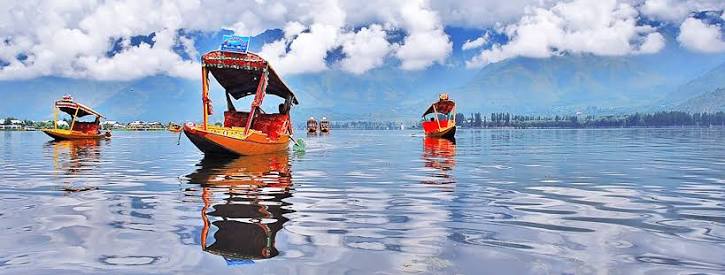
Shikara rides across Dal Lake, terraced Mughal gardens and houseboats carved from cedar define Kashmir's summer capital.
Srinagar, the summer capital of Jammu and Kashmir, is a city where lakes, mountains, Mughal gardens, heritage and Kashmiri culture come together. Set in the heart of the Kashmir Valley, it is best known for the serene Dal Lake, colourful shikaras, traditional houseboats and the snow-dusted mountains that frame the city. But Srinagar is much more than a gateway to Kashmir—it is a destination worth experiencing at its own pace.
At the centre of the Srinagar experience is Dal Lake, often described as the “Jewel in the Crown of Kashmir.” Its shoreline is surrounded by gardens, parks, hotels and houseboats, while shikaras provide one of the most distinctive ways to experience the city. The lake is also home to floating gardens and a long-standing local culture built around fishing, horticulture and life on the water.
A shikara ride is more than a sightseeing activity here. It offers a slower perspective of Srinagar, allowing you to watch everyday life unfold around the lake while taking in reflections of the surrounding Zabarwan mountains. Staying in a traditional houseboat can make the experience even more memorable.
Explore Srinagar Beyond Dal Lake
Srinagar’s Mughal heritage adds another layer to the city. Shalimar Bagh, Nishat Bagh and Chashme Shahi are historic terraced gardens built around flowing water, fountains, flowerbeds and views of the surrounding landscape. Shalimar Bagh, commissioned by Emperor Jahangir for Nur Jahan in 1619, remains one of the city’s most celebrated heritage attractions.
For panoramic views, Pari Mahal sits high on the Zabarwan range overlooking Srinagar and Dal Lake. The seven-terraced structure was built by Prince Dara Shikoh in the mid-17th century and was later used as an observatory.
The city also offers opportunities to explore Kashmiri handicrafts, traditional markets and local food. Its old neighbourhoods and bazaars provide a glimpse into a side of Srinagar that can easily be missed when travelling only between major attractions. The official district tourism portal highlights the city’s heritage, handicrafts and local cultural traditions alongside its natural attractions.
Srinagar changes character with the seasons. Spring brings flowers and gardens to life, summer offers pleasant opportunities to explore the lakes and surrounding attractions, autumn transforms the famous chinar trees into shades of gold and red, while winter can bring a distinctly colder, snow-filled atmosphere. Kashmir Tourism lists April to October as the main season, with December to February offering a winter experience for travellers seeking snow and colder weather.
For a first visit, 3–4 days allows enough time to enjoy Dal Lake, explore the Mughal gardens, discover the city’s heritage and leave room for unhurried moments by the water. The real charm of Srinagar comes when you slow down—take a shikara at the right time of day, walk through a garden, explore a local market and simply watch the mountains change colour.
Srinagar is not just a stop on a Kashmir itinerary. It is where the story of Kashmir begins—with water, mountains, gardens, craftsmanship and a culture that rewards travellers who take their time.
Location on Map
WHY VISIT
Why Visit Srinagar?
Discover what makes Srinagar a destination worth experiencing.
Scenery
The landscapes around Srinagar are the main reason most people make the trip.
Local Culture
Food, festivals and daily life in Jammu & Kashmir that you will not find in a guidebook.
Things To Do
Enough to fill 3-4 days without rushing between sights.
Best Season
Apr-Oct offers the clearest weather and the most open routes.
Photo Gallery
Discover Srinagar through beautiful photographs.
Top Attractions
Srinagar Main Viewpoint
The most photographed outlook in Srinagar, best in the soft light just after sunrise.
1 Hour
Free
Best Time:
Sunrise
Srinagar Old Quarter Walk
A slow wander through the older lanes of Srinagar, where the everyday rhythm of Jammu & Kashmir is easiest to see.
2-3 Hours
Free
Best Time:
Morning
Srinagar Heritage Site
The principal historic or natural landmark at Srinagar and the reason most itineraries include it.
2 Hours
Rs 25-600
Best Time:
Morning
Srinagar Local Market
Produce, crafts and street food. Come hungry and carry small notes.
1-2 Hours
Free
Best Time:
Late afternoon
Srinagar Sunset Point
The spot locals head to at the end of the day, and usually the best photograph you will take in Srinagar.
1 Hour
Free
Best Time:
Sunset
Suggested Itinerary
1
Arrival and Settling In
Meals
Breakfast not included
2
The Main Sights
Meals
Breakfast
3
Getting Out of Town
Meals
Breakfast, packed lunch
4
Slow Morning and Departure
Meals
Breakfast
Estimated Budget
Accommodation
4800
Mid-range guesthouse or 3-star hotel, per night.
Food and Drink
2600
Three meals a day at local restaurants.
Local Transport
2200
Shared taxis, autos and short transfers.
Activities and Entry
1700
Site entry fees and one paid activity.
Miscellaneous
700
Tips, SIM, laundry and small extras.
Weather & Best Time to Visit
Understand the weather throughout the year to plan the perfect trip.
January
Moderate
Temperature
-5 to 10 C
Rainfall
Minimal
Humidity
Low
February
Moderate
Temperature
-5 to 10 C
Rainfall
Minimal
Humidity
Low
March
Moderate
Temperature
15 to 25 C
Rainfall
Minimal
Humidity
Low
April
High
Temperature
15 to 25 C
Rainfall
Minimal
Humidity
Low
May
High
Temperature
15 to 25 C
Rainfall
Light
Humidity
Moderate
June
High
Temperature
12 to 22 C
Rainfall
Minimal
Humidity
Low
July
High
Temperature
12 to 22 C
Rainfall
Minimal
Humidity
Low
August
High
Temperature
12 to 22 C
Rainfall
Minimal
Humidity
Low
September
High
Temperature
15 to 25 C
Rainfall
Minimal
Humidity
Low
October
High
Temperature
15 to 25 C
Rainfall
Light
Humidity
Moderate
November
Moderate
Temperature
15 to 25 C
Rainfall
Minimal
Humidity
Low
December
Moderate
Temperature
-5 to 10 C
Rainfall
Minimal
Humidity
Low
Travel Information
Everything you need to know before planning your journey.
Destination Facts
State
Jammu & Kashmir
Best Time
Apr-Oct
Ideal Duration
3-4 Days
Starting Budget
Rs 12,000 per person
Coordinates
34.0837, 74.7973
Region
North India
Languages
Hindi, English and the local language of Jammu & Kashmir
Our Rating
5 out of 5
Travel Essentials
Currency
Indian Rupee (INR)
Language
Hindi, English and the local language of Jammu & Kashmir
Emergency
112 (national emergency number)
Connectivity
Jio and Airtel have the widest coverage
Getting Around
Autos, shared taxis and app cabs where available
What to Pack
Layers suited to Apr-Oct
Health
Drink filtered or bottled water only
Connectivity Tip
Carry a power bank
Frequently Asked Questions
Apr-Oct is the most comfortable window for Srinagar, with the most reliable weather for sightseeing and outdoor activity.
Around 3-4 days covers the main sights at a relaxed pace. Add a day or two if you want day trips nearby.
Budget from roughly Rs 12,000 per person for accommodation, food and local transport, excluding long-distance travel to Jammu & Kashmir.
Srinagar is in Jammu & Kashmir, north india, at approximately 34.0837, 74.7973.